أخبار
Fused Sight Glass vs. Conventional Bolted Sight Glass: Which Is Better?
Fused Sight Glass vs. Conventional Bolted Sight Glass: Which Is Better?
“Which sight glass is better?” sounds like a simple purchasing question, but there is no universal winner. A fused sight glass can reduce the number of separate parts and sealing interfaces around the glass. A conventional bolted assembly can offer familiar construction, replaceable components, and flexibility for large or customized viewing openings.
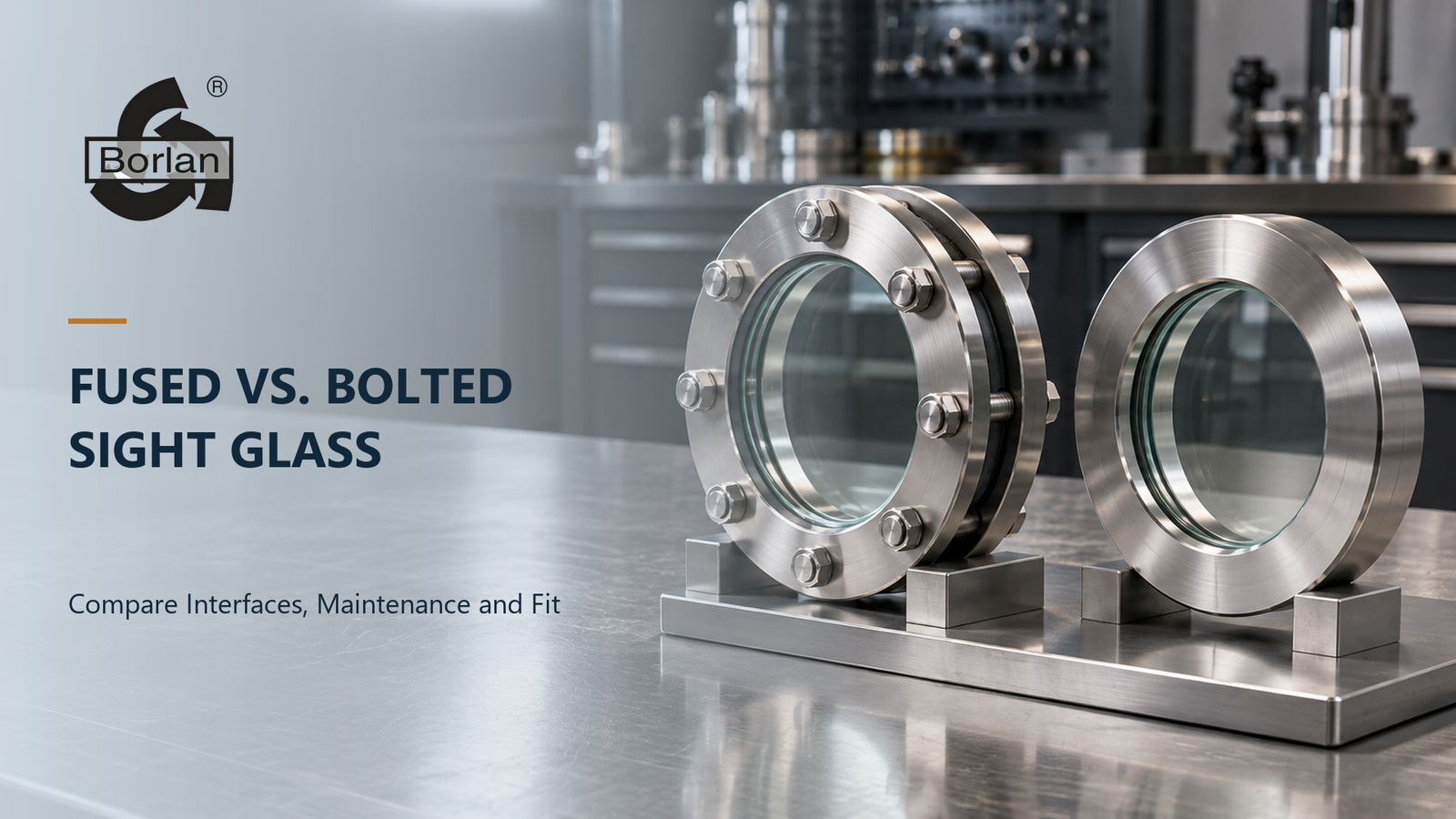
There is also an important terminology point. “Fused” describes how the glass is integrated with a metal carrier. “Bolted” describes how parts or flanges are mechanically retained. A fused window can itself be installed in a bolted-flange assembly. In this article, “conventional bolted sight glass” means the familiar construction in which a separate glass disc is compressed between gaskets and metal retaining parts. The comparison is between two window constructions, not two words that are always mutually exclusive.
How the Two Constructions Differ
Conventional Bolted Sight Glass
A conventional bolted sight glass usually includes a loose glass disc, one or more gaskets or cushions, a body or base flange, a cover or retaining ring, and a set of fasteners. Tightening the fasteners creates the compression needed to hold and seal the glass.
This arrangement can be dependable when the glass is properly supported, the sealing materials suit the medium and temperature, the mating surfaces are flat, and the fasteners are tightened evenly. It also gives maintenance teams access to separate replaceable parts. Its main engineering challenge is that the final assembly condition depends on several interfaces and field-controlled variables.
Fused Sight Glass
A fused sight glass integrates the glass with a metal carrier during manufacture. The installer handles an engineered glass-to-metal window component rather than rebuilding a loose glass-and-gasket retaining stack around the viewing area. For a deeper explanation, see fused sight glass construction.
Integration can remove some internal gasketed interfaces, but it does not remove every seal from the complete installation. A clamp gasket, flange gasket, O-ring, weld, or other equipment connection may still be required. Material compatibility, geometry, thermal-expansion behavior, manufacturing control, and installation conditions still matter.
Side-by-Side Engineering Comparison
| Decision factor | Conventional bolted construction | Fused construction |
|---|---|---|
| Glass-retaining interface | Separate glass, gaskets, retaining parts, and fasteners | Glass and metal carrier form an integrated window component |
| Field assembly variables | More parts must be positioned and compressed correctly | Fewer loose parts around the glass, but the external connection still requires correct sealing |
| Maintenance approach | Individual glass and gasket parts may be replaced when the design permits | The integrated window is normally treated as one component |
| Geometry and aperture | Often suitable for familiar circular assemblies and custom or larger openings, subject to engineering review | Often selected for compact, integrated windows; available geometry depends on the manufactured range |
| Gasket dependence | Internal glass-retaining gaskets are central to sealing and load distribution | Internal interfaces may be reduced; an external soft seal may still be required |
| Installation sensitivity | Flatness, gasket placement, tightening sequence, and fastener load are critical | Mating surface, connection gasket, alignment, and external loading remain critical |
| Thermal conditions | Glass support, gasket behavior, and differential expansion must be evaluated | Glass-to-metal interface and complete component thermal envelope must be evaluated |
| Procurement | Separate replacement parts may be easier to specify for a legacy design | Exact integrated window, connection, and supporting documentation must be matched |
The table shows why the decision cannot be reduced to “new technology versus old technology.” Each design moves engineering responsibility to different interfaces.
When a Fused Sight Glass May Be the Better Fit
When You Want Fewer Internal Interfaces
Integrating the glass with a metal carrier can remove loose internal retaining parts and gasketed surfaces around the window. That may reduce the number of components that must be aligned, cleaned, inspected, and reassembled. This is a risk-reduction mechanism, not a guarantee of zero leakage.
When Compact Construction Is Valuable
A fused window can provide a compact profile and a flatter, step-reduced contact side in suitable configurations. That can be useful where installation space is limited or where reducing recesses supports the equipment’s cleaning concept. Fused construction alone does not establish hygienic compliance; surface finish, welds, drainability, gasket geometry, orientation, and documentation must still be checked.
When Repeatable Component Replacement Is Preferred
Replacing one identified window component can reduce ambiguity about the order and orientation of loose retaining parts. This can simplify maintenance planning when the exact replacement part is controlled by drawing, batch, or part number. The external seal and mating surface still require inspection during replacement.
When the Application Justifies a More Integrated Solution
Processes that place a high value on controlling internal interfaces may justify evaluating a fused design. The decision should be based on verified service conditions and model-specific documentation, not on the word “fused” alone. Pressure, vacuum, temperature, thermal ramp, media, cleaning chemistry, connection, and required certification must all be defined.
When a Conventional Bolted Sight Glass May Be the Better Fit
When Individual Parts Must Be Field-Replaceable
Some plants prefer to stock glass discs, gaskets, and fasteners separately and rebuild the assembly on site. A conventional design can support that maintenance model when trained personnel, correct procedures, and controlled spare parts are available.
When You Are Matching Existing Equipment
Legacy vessels may already have a defined bolt pattern, flange geometry, recess, and clear aperture. Retaining the established construction can avoid unnecessary modification, provided the original design remains suitable for current service. The replacement glass and gasket must match the actual drawing—not merely the nominal diameter.
When Size or Custom Geometry Drives the Design
Large, rectangular, elongated, or project-specific windows may favor a mechanically retained arrangement. That does not make conventional construction automatically cheaper or safer. The support geometry, glass dimensions, gasket loading, fastener arrangement, and design verification become increasingly important as the opening changes.
When the Maintenance Team Has a Proven Procedure
A well-documented bolted assembly with controlled tightening, inspection, and replacement intervals may be entirely appropriate. Changing to another construction only makes sense if it solves a defined problem such as excessive part count, repeated assembly errors, unavailable spares, or an unsuitable contact geometry.
Sealing and Maintenance: Where Failures Actually Start
For a conventional bolted unit, common risk points include incorrect gasket material, damaged or contaminated sealing surfaces, a mispositioned glass disc, uneven tightening, over-compression, and reuse of parts that no longer recover correctly. Selection of sight glass gasket materials should consider the product medium, cleaning chemicals, temperature, geometry, and applicable regulatory requirements.
For a fused unit, the integrated glass-to-metal junction removes some of those internal assembly variables. However, the equipment connection can still fail because of a wrong gasket, a damaged mating face, misalignment, external piping load, unsuitable welding, impact, or operation outside verified limits.
The maintenance comparison is therefore not “maintenance versus no maintenance.” It is “a rebuildable stack with more field-controlled interfaces” versus “an integrated window with fewer internal interfaces but a component-level replacement strategy.”
Thermal Cycling and Mechanical Loading
Glass is brittle, and glass and metal do not respond identically to temperature change. Both constructions require an operating envelope that accounts for temperature, heating and cooling rate, pressure or vacuum, glass geometry, metal geometry, support, and connection condition.
Do not assume that fused construction permits unlimited thermal shock. Borlan’s current catalog instructs users of its fused range to control heating and cooling rates and use a soft seal at the applicable contact surface. The exact allowable temperature, ramp rate, pressure, and cycle conditions must be confirmed for the selected model and size.
Conventional bolted units also need controlled loading. Uneven or excessive fastener force can create nonuniform stress in the glass. Installation should use the specified tightening sequence and values, verified flat surfaces, compatible gaskets, and correct alignment. Neither type should be forced into position to correct distorted equipment.
A Five-Step Selection Method
1. Define the Complete Service Case
List the process medium and concentration, cleaning chemicals, normal and design pressure, vacuum condition, minimum and maximum temperature, heating and cooling rate, cycle frequency, orientation, vibration, and external loads. Industry name alone is not enough.
2. Define the Mechanical Interface
Provide the actual connection standard, nominal size, dimensions, bolt pattern or clamp profile, clear viewing diameter, available space, and weld or flange arrangement. Review sight glass connection options before treating connection type as a secondary detail.
3. Compare Maintenance Strategies
Decide whether the plant prefers separate field-replaceable glass and gaskets or a controlled integrated replacement component. Include technician training, spare-part identification, shutdown time, inspection access, and the risk of assembly variation.
4. Request Configuration-Specific Evidence
Ask for the drawing, materials, operating limits, inspection documents, traceability, and any project-required certificates for the exact size and configuration. Evidence for one model, size, material, or certificate scope should not be applied automatically to another.
5. Compare Total Application Fit
Purchase price is only one factor. Consider installation changes, replacement-part strategy, cleaning access, downtime, inspection burden, and documentation. A lower-cost component can be the wrong choice if it increases recurring maintenance risk; a more integrated component can also be unnecessary if the existing bolted design is well controlled.
الأسئلة الشائعة
Is a fused sight glass always safer than a bolted one?
No. Fused construction can reduce internal interfaces and assembly variables, but overall safety depends on the selected model, operating limits, external connection, installation, inspection, and supporting evidence.
Can a fused sight glass use a bolted flange?
Yes. “Fused” refers to the glass-to-metal window construction, while “bolted flange” refers to the equipment connection or retention method. A fused window may be incorporated into a bolted-flange assembly.
Is a conventional bolted sight glass outdated?
No. It remains a practical construction where replaceable parts, established equipment geometry, custom openings, or existing maintenance procedures are important. It must still be correctly engineered and assembled.
Does a fused sight glass need a gasket?
It may still need a gasket or soft seal at the connection to the vessel, pipe, clamp, or flange. Integrated glass-to-metal construction does not mean that the entire installation is gasket-free.
Which design costs less?
The answer depends on size, materials, connection, manufacturing complexity, spares, installation changes, maintenance labor, downtime, and documentation. Compare the full configuration and life-cycle implications rather than only the window price.
The Better Sight Glass Is the Better-Defined Configuration
Choose fused construction when fewer internal interfaces, compactness, and a controlled integrated component directly address the application. Choose conventional bolted construction when replaceable parts, existing geometry, custom apertures, or a proven maintenance method are stronger priorities.
Borlan Fluid supplies conventional and fused sight glass configurations for different equipment interfaces. Availability and claims must be confirmed for the exact model, material, size, and service conditions. Contact Borlan Fluid for a side-by-side review and provide the medium, pressure, vacuum, temperature range, heating and cooling rate, size, connection, clear aperture, materials, cleaning method, and required documents. A complete RFQ makes the comparison technically meaningful.