News
How Pressure, Temperature, Vacuum, and Media Affect Sight Glass Selection
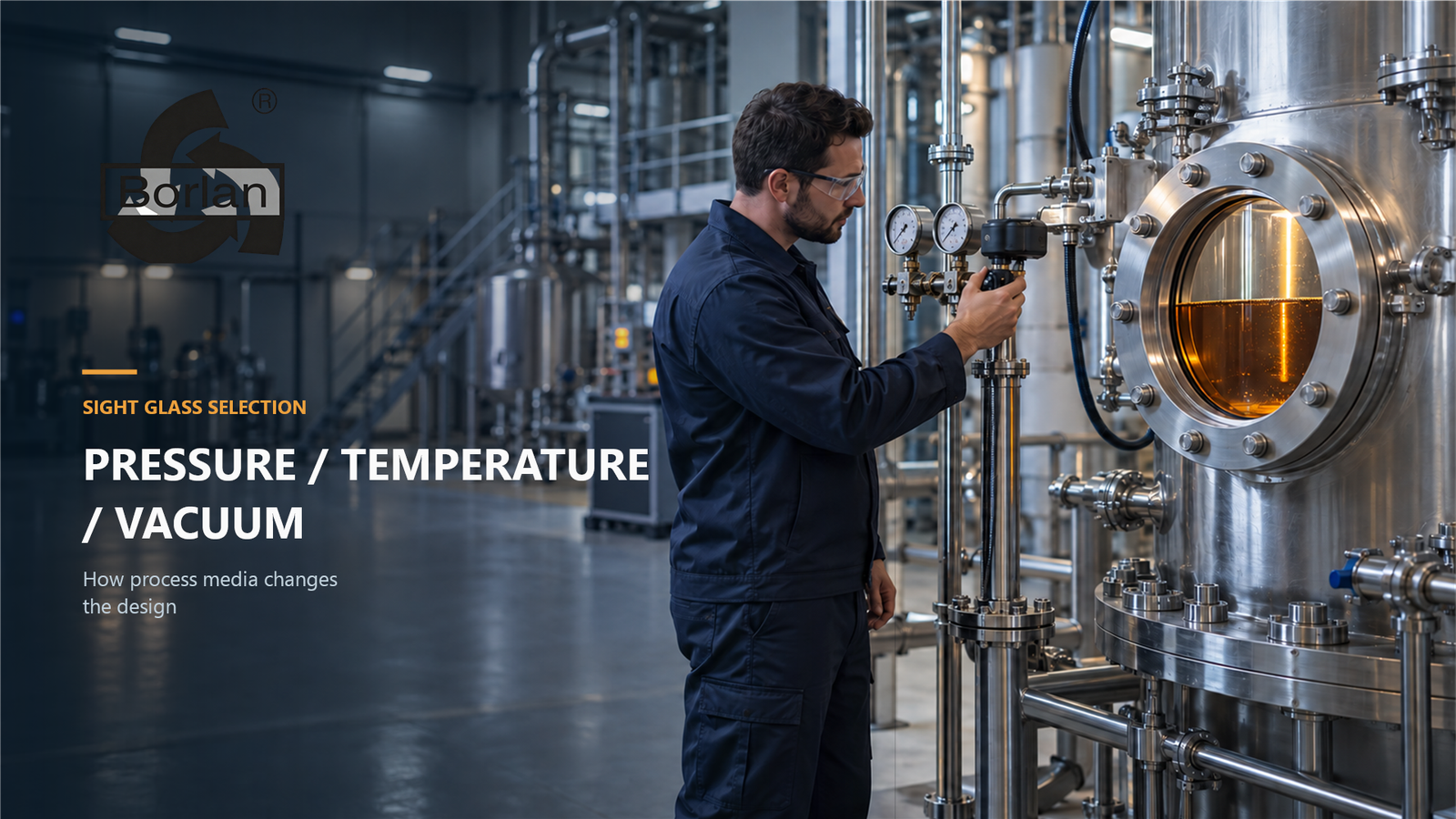
A sight glass is both an observation window and part of the process boundary. Its metal body, transparent window, gaskets, fasteners, and connection must work together under the real operating conditions. Selecting one from nominal size alone can overlook the loads that determine sealing reliability, visibility, and service life.
Four variables deserve particular attention: pressure, temperature, vacuum, and process media. They are not independent boxes on a datasheet: heat can change gasket behavior, a rapid cold wash can stress a hot window, and vacuum can load the seal differently from positive pressure.
This guide explains what each condition changes, how the conditions interact, and what to send a manufacturer before requesting a quotation.
Sight Glass Operating Conditions: A Quick Selection Matrix
| Condition | Information to specify | Components affected | Commonly missed detail |
|---|---|---|---|
| Pressure | Normal, maximum/design, surge, pulsation, and test conditions | Window, body, support geometry, fasteners, gasket, connection | A pressure test can exceed normal operating pressure |
| Temperature | Minimum, normal, maximum, cleaning temperature, rate of change, and cycle frequency | Glass, gasket, metal body, preload, surface finish | Rapid heating or cooling can matter more than steady temperature |
| Vacuum | Normal and deepest vacuum, duration, cycling, and possible full vacuum | Window support, seal direction, gasket behavior, external-load resistance | “Negative pressure” is not a complete vacuum specification |
| Media | Exact chemistry, concentration, solids, viscosity, abrasiveness, and cleaning agents | Wetted metal, glass, gasket, internal geometry, visibility | Cleaning chemicals may be more aggressive than the product |
This matrix is a starting point, not a rating chart. Allowable conditions must be confirmed for the exact model, size, material, glass, gasket, and connection.
1. Pressure Affects More Than Glass Thickness
Internal pressure loads the transparent window, its supporting metal geometry, the seal, fasteners, and the connection to the vessel or pipe. Increasing the clear viewing diameter can significantly change the load on the window, so a rating for one size should never be assumed to cover another.
Provide the manufacturer with:
- normal operating pressure;
- maximum operating or design pressure;
- pressure surges, pulsation, or rapid cycling;
- hydrostatic or pneumatic test pressure;
- pressure duration and cycle frequency; and
- the applicable equipment or piping design basis.
Steady pressure and repeated cycling are different engineering cases. Pulsation, vibration, nozzle distortion, piping loads, and uneven tightening can add stresses that are not visible in a pressure value alone.
Do not infer pressure capability from the words “flanged,” “clamp,” or “heavy duty.” Our guide to sight glass connection types explains why the interface name must be separated from the verified capacity of the complete assembly.
2. Temperature Includes Thermal Change, Not Just a Maximum
A maximum process temperature is important, but it does not describe the entire thermal duty. Sight glass materials expand at different rates. Temperature changes can alter gasket stiffness and compression, while steep gradients can create thermal stress in the window.
Specify minimum, normal, and maximum temperature together with every relevant operating phase. Include startup, shutdown, steam or hot-water cleaning, sterilization, defrosting, ambient exposure, insulation, and nearby heat sources. Also state how quickly the temperature can change and how often the cycle occurs.
Why Thermal Shock Matters
A hot vessel washed with cold liquid—or a cold window suddenly exposed to hot cleaning fluid—can experience a larger thermal gradient than the normal process temperature suggests.
Some fused glass-to-metal products have model-specific heating and cooling instructions. Follow the documentation for the exact configuration rather than applying one catalog value to every sight glass. If thermal cycling is severe, make it a design input before the window, seal, and mounting method are chosen.
3. Vacuum Is a Distinct Structural and Sealing Case
Under internal vacuum, atmospheric pressure acts from outside toward the vessel. The load direction is therefore different from positive internal pressure, and the seal may be pulled or supported in a different way. The assembly must also maintain useful visibility without allowing leakage that compromises the process.
“Suitable for negative pressure” is too vague for procurement. State the deepest operating vacuum in an agreed unit, whether full vacuum is possible, how long the condition lasts, whether the vessel cycles between pressure and vacuum, and whether vacuum occurs at elevated or reduced temperature.
Ask the supplier to confirm the complete assembly for that service: window, support geometry, gasket arrangement, connection, fasteners, and installation orientation. A positive-pressure statement does not automatically prove full-vacuum suitability.
4. Process Media Determine Compatibility and Visibility
“Chemical,” “food,” or “water” is not an adequate media description. Provide the actual product or chemical family, concentration, additives, pH where relevant, solids content, viscosity, operating temperature, and known corrosive or abrasive components.
Media influence at least four selection decisions:
- Wetted metal: Chlorides, acids, salts, solvents, deposits, and cleaning chemistry affect stainless steel selection. The 304 vs. 316L sight glass guide explains why the wetted boundary matters more than appearance.
- Gasket material: Seal families differ in chemical resistance, temperature behavior, permeability, and compression set. Grade and formulation still require confirmation.
- Window and internal geometry: Abrasive solids, crystallizing products, sticky media, or deposits can reduce clarity and complicate cleaning. A flush or low-ledged internal surface may be useful when residue control is a priority.
- Observation quality: Color, opacity, foam, suspended solids, and vessel depth determine the useful clear aperture and whether dedicated illumination is needed.
Always include cleaning and sterilization fluids in the compatibility review. The process product may be mild while a concentrated cleaner, steam cycle, or rinse sequence creates the more demanding exposure.
The Four Conditions Must Be Evaluated Together
The safest selection comes from combinations, not isolated maximum values. Consider these examples:
- Hot cleaning after a cool process: The nominal product temperature may be modest, but the rapid cleaning transition can govern window and gasket selection.
- Vacuum with a volatile solvent: Chemical compatibility, permeation, vacuum tightness, and temperature must be reviewed as one case.
- Pressurized abrasive slurry: Pressure capacity alone does not address erosion, deposits, loss of visibility, or cleaning access.
- Pressure-vacuum cycling: Reversing load direction can challenge the seal and retaining arrangement differently from steady service.
- Chloride-bearing hot media: Temperature can accelerate corrosion risk, making metal grade, surface condition, crevices, and deposits more important.
A useful rule is to define the worst credible combination that can actually occur—not an impossible combination of unrelated maxima, and not four separate values with no operating sequence.
How Operating Conditions Change the Final Construction
Once the duty is clear, the manufacturer can review the complete configuration.
Metal Body and Wetted Parts
Select the metal against the actual medium, cleaning chemistry, temperature, fabrication method, surface condition, and documentation requirement. Clearly identify which components are wetted and which are external.
Window Construction and Clear Aperture
Confirm the glass type, clear viewing diameter, thickness, edge protection, support geometry, and whether a mechanically sealed or fused construction is appropriate. Borlan Fluid offers conventional stainless steel and fused sight glass solutions, but suitability must be checked for the specified size and service.
Gaskets and Seals
The seal must remain compatible with both the process and cleaning cycle while maintaining the required compression across temperature and pressure changes. Profile, surface condition, assembly method, and replacement practice are as important as the material name.
Connection and Installation
Clamp, union, flange, weld-on, and custom interfaces offer different maintenance and installation characteristics. Confirm the exact standard or dimensions, orientation, available service space, nozzle condition, external loads, and tightening method.
Common Specification Mistakes
- Providing only normal pressure and omitting test or surge conditions.
- Giving a maximum temperature without the heating or cooling rate.
- Writing “vacuum” without a value, duration, or cycling information.
- Naming an industry instead of the actual medium and concentration.
- Checking product compatibility but omitting cleaning chemicals.
- Assuming one material choice makes the entire assembly suitable.
- Reusing a rating from another diameter, gasket, or connection.
RFQ Checklist for Operating Conditions
Copy this list into your next inquiry:
- Equipment type and observation purpose.
- Process medium, concentration, additives, solids, viscosity, and abrasiveness.
- Cleaning or sterilization chemicals, concentration, time, and temperature.
- Normal, maximum/design, surge, pulsation, and test pressure.
- Vacuum level, duration, full-vacuum possibility, and pressure-vacuum cycling.
- Minimum, normal, and maximum temperature.
- Heating and cooling rate, cycle frequency, and abnormal transitions.
- Connection type, standard, size, mating dimensions, and orientation.
- Required clear viewing area, lighting, and operator viewing distance.
- Wetted metal, glass, gasket, and surface-finish requirements.
- Applicable design code, inspection documents, and destination-country requirements.
- Drawing, photos, quantity, and delivery target.
How Borlan Fluid Can Support Selection
Borlan Fluid manufactures stainless steel sight glasses, fused sight glass configurations, pipeline sight glasses, sight glass lights, and related tank accessories. Standard and non-standard projects can be reviewed from operating data, drawings, measured interfaces, or samples.
The most productive inquiry is not “What pressure can your sight glass handle?” but “Which exact configuration fits this complete operating case?” Send the actual conditions and interface details so the proposed materials, window, seal, and connection can be reviewed together.
Frequently Asked Questions
Can One Sight Glass Rating Cover Every Gasket or Size?
No. Size, clear aperture, glass, gasket, body geometry, connection, temperature, and assembly method can all change allowable service. Confirm the exact configuration.
Is Full Vacuum Less Demanding Than Positive Pressure?
Not necessarily. Vacuum reverses the load direction and may affect the seal and window support differently. It requires its own verified assessment.
Is Maximum Temperature Enough for Selection?
No. Minimum temperature, cleaning cycles, thermal gradients, rate of change, and frequency can be equally important.
What If the Process Formula Is Confidential?
Provide a compatibility statement or disclose the relevant chemical family, concentration range, temperature, cleaning agents, solids, and other properties needed for material review. The equipment designer or end user should retain final compatibility approval.
Conclusion
Pressure, temperature, vacuum, and media work together to define sight glass duty. Accurate selection requires the operating sequence, not just four headline values. Treat the window, metal body, gasket, fasteners, and connection as one assembly, and verify the exact size and configuration against the real process.
For a new or replacement unit, Contact Borlan Fluid with the RFQ checklist, drawings, and mating dimensions for a configuration review and quotation.