

Noticias
304 vs. 316L Stainless Steel for Sight Glass Assemblies
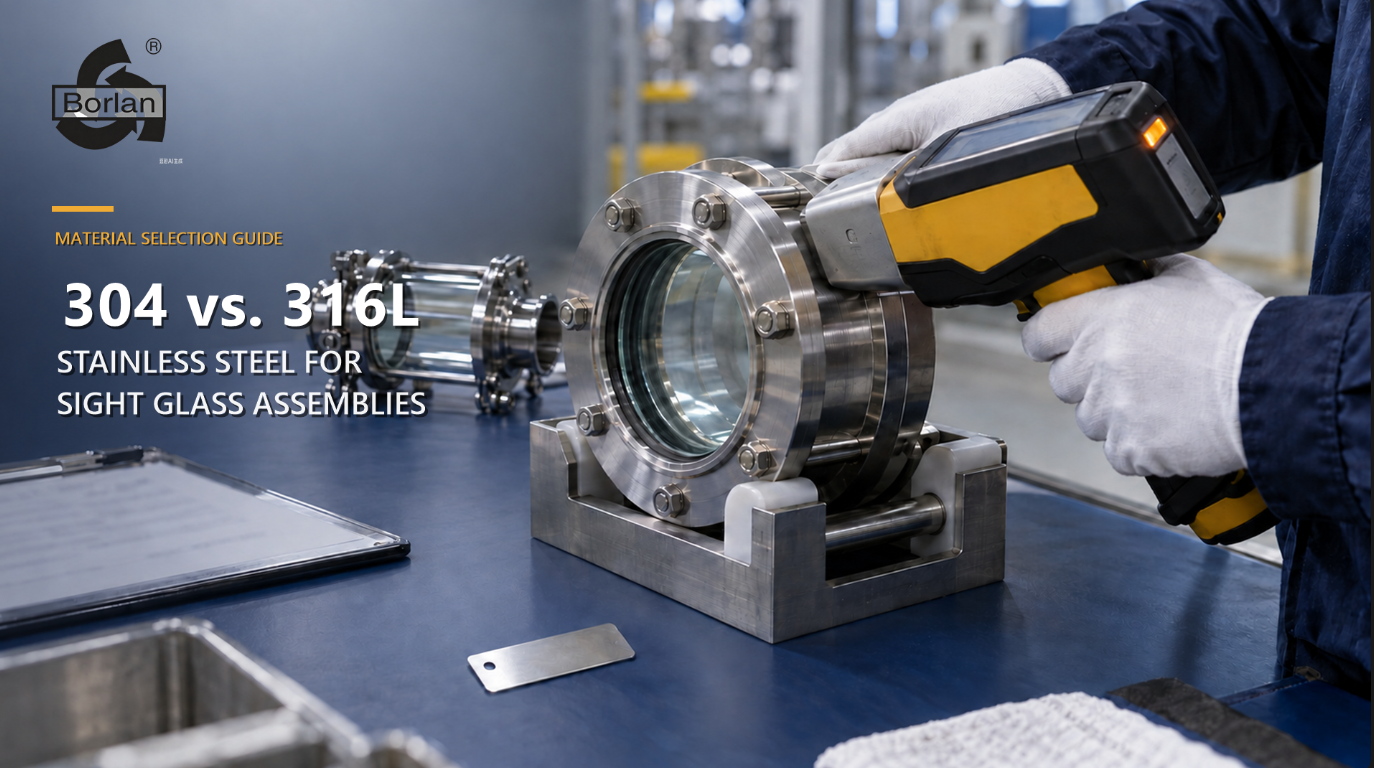
304 vs. 316L Stainless Steel for Sight Glass Assemblies
Stainless steel is widely used for sight glass bodies, flanges, unions, clamp ferrules, protective components, and related tank accessories. Buyers commonly face a choice between 304 and 316L, but the best answer is not simply “316L is better.”
Both grades can provide good fabrication performance and corrosion resistance in suitable environments. The difference becomes important when the sight glass contacts chlorides, salts, aggressive cleaning chemicals, pharmaceutical or food products, or process media that can attack stainless steel. Welding, surface condition, temperature, stagnant deposits, and documentation requirements also influence the decision.
This guide explains the practical differences and the information a manufacturer needs before recommending a material.
304 vs. 316L: Quick Comparison
| Selection point | acero inoxidable 304 | acero inoxidable 316L |
|---|---|---|
| General composition difference | Chromium-nickel austenitic stainless steel | Chromium-nickel-molybdenum austenitic stainless steel with low carbon |
| Corrosion performance | Suitable for many mild process, utility, indoor, and non-aggressive duties | Generally offers better resistance to localized corrosion in many chloride-bearing environments |
| Welding consideration | Commonly fabricated and welded; the exact grade and post-fabrication condition still matter | Low carbon content helps reduce sensitization risk in welded areas when fabrication is properly controlled |
| Common reason to select | Adequate performance at lower material cost | More demanding wetted service, welding, or customer specification |
| Price | Normally lower | Normally higher because of alloy content and market conditions |
| Identification | Cannot be confirmed reliably by appearance | Cannot be confirmed reliably by appearance; records or testing are needed |
This comparison is general guidance. Neither grade is universally corrosion-proof, and neither grade alone defines the pressure, temperature, hygiene, or service life of a complete sight glass.
What Changes When Molybdenum Is Added?
The main practical distinction is that 316L contains molybdenum, while standard 304 does not intentionally use molybdenum as a principal alloying addition. Molybdenum can improve resistance to localized forms of corrosion such as pitting and crevice attack in many chloride-containing environments.
That advantage matters around gasket interfaces, narrow gaps, deposits, and poorly drained areas, where the local environment can become more aggressive than the bulk liquid. However, 316L is not immune to chlorides. Concentration, temperature, oxygen, acidity, exposure time, deposits, cleaning cycles, and mechanical stress can all change performance.
Material selection should therefore be based on the actual medium and cleaning process, not on a broad statement such as “salt water requires 316L.” A highly concentrated, hot, stagnant chloride solution may require a different alloy or a revised design even when 316L is considered.
What Does the “L” in 316L Mean?
The “L” indicates a low-carbon version of 316 stainless steel. Lower carbon content helps reduce the risk of chromium carbide precipitation and loss of corrosion resistance near weld heat-affected zones.
This is valuable for welded wetted components, but the grade name does not replace welding control. Filler material, heat input, shielding, contamination, weld geometry, cleaning, pickling, passivation, and inspection can all affect the finished assembly.
Buyers should also avoid treating “316” and “316L” as interchangeable wording. If the project requires 316L, state 316L on the inquiry, drawing, purchase order, and material certificate requirement.
When 304 Can Be the Practical Choice
304 can be appropriate when the process medium is mild, chloride exposure is low, cleaning chemicals are compatible, and the customer’s design standard does not require 316L.
Examples may include:
- Indoor utility or water-service equipment with controlled chemistry
- Dry external covers, brackets, handles, and non-wetted guards
- General-purpose tanks with non-aggressive contents
- Projects where the sight glass is inspected and cleaned manually
- Cost-sensitive equipment where service conditions are well understood
Using 304 where it is technically sufficient can control cost without reducing required performance. The decision should still consider condensation, washdown water, coastal atmosphere, insulation, external chemical exposure, and maintenance practices—not only the liquid inside the vessel.
Borlan Fluid’s stainless steel sight glass range includes multiple connection and viewing arrangements that can be reviewed against the customer’s material boundary and operating data.
When 316L May Be Preferred
316L is often considered for wetted components exposed to chlorides, salts, demanding cleaning chemicals, pharmaceutical or biotechnology processes, and projects that specifically require low-carbon stainless steel.
It may also be preferred when:
- The wetted body or ferrules will be welded
- The customer requires 316L material traceability
- Cleaning and sterilization cycles create a more demanding environment
- Product contamination and corrosion products present a high consequence
- The equipment operates in a coastal, marine, or frequent-washdown environment
- Lifecycle reliability is more important than the lowest initial material cost
For hygienic pipelines, material grade is only one selection factor. Bore geometry, gasket alignment, surface condition, drainability, connection standard, cleaning procedure, and documentation remain essential. Borlan Fluid’s mirillas para tuberías sanitarias can be evaluated in 304 or 316L configurations according to the specific inquiry and drawing.
Define the Wetted Material Boundary
One of the most important purchasing questions is: which parts must actually be 316L?
A sight glass assembly may include a body, ferrules or flange, retaining ring, fasteners, protective guard, lamp bracket, glass, and gasket. Not all stainless components necessarily contact the process medium.
A quotation described only as “316L sight glass” can therefore be misunderstood. A clearer specification might state:
All stainless steel wetted parts shall be 316L. Non-wetted external guard and fasteners may be 304 unless otherwise specified.
Alternatively, a regulated or highly corrosive project may require every named stainless component to be 316L. The supplier should identify the material boundary in the quotation and drawing instead of relying on a short product description.
This distinction is especially useful for guarded tubular sight glasses and illuminated assemblies, where external supports or covers can represent a meaningful part of the total material cost.
Material Grade Is Only One Part of Corrosion Control
Selecting 316L cannot compensate for poor fabrication or an unsuitable assembly. Review the following factors together:
Surface Condition
Grinding contamination, embedded carbon steel particles, heat tint, rough welds, and damaged passive surfaces can reduce corrosion performance. Surface treatment and handling should match the service requirement.
Crevices and Drainage
Gasket gaps, protruding seals, stagnant pockets, and deposits can create locally aggressive conditions. A cleanable and drainable design may improve performance more than a material upgrade alone.
Gasket and Glass Compatibility
The stainless body is only one part of the wetted assembly. The gasket and viewing glass must also tolerate the medium, pressure, vacuum, operating temperature, cleaning chemicals, and thermal cycling.
Where a flush contact surface is required, review Borlan Fluid’s fused sight glass solutions together with the model-specific installation and thermal limitations.
Galvanic and External Exposure
Mixed metals, conductive liquids, salt deposits, and wet insulation can affect corrosion behavior. External parts may require attention even when they do not contact the process fluid.
How to Verify 304 or 316L
The two grades normally look the same. Surface shine, magnet response, weight, or color is not a reliable purchasing test.
Depending on the project, verification may include:
- A material certificate linked to the supplied heat or batch
- Purchase and production traceability records
- Positive material identification using an appropriate alloy analyzer
- Supplier inspection reports
- Customer or third-party testing when contractually required
Verification scope should be agreed before production. Portable alloy analyzers can help distinguish alloy chemistry, but the test method and instrument capability must match the acceptance requirement. For example, confirming the low carbon level associated with the “L” grade may require documentation or a test method capable of measuring carbon rather than a basic handheld screening result.
Borlan Fluid can review drawings, material boundaries, and non-standard requirements through its custom sight glass manufacturing support. Required certificates, testing, and marking should be listed in the RFQ rather than requested after production.
RFQ Checklist for Material Selection
Provide the following information:
- Process medium and concentration
- Normal and maximum operating temperature
- Pressure and vacuum conditions
- Chloride, salt, acid, alkali, or solvent exposure
- Cleaning chemicals, concentration, temperature, and cycle frequency
- Manual cleaning, CIP, SIP, or washdown requirements
- Which components are wetted
- Required grade for wetted and non-wetted parts
- Connection type, standard, size, and drawing
- Welding and surface-finish requirements
- Glass and gasket materials
- Indoor, outdoor, coastal, or marine installation
- Material certificate, traceability, PMI, inspection, or marking requirements
- Quantity and destination country
Contact Borlan Fluid with these parameters for a material and configuration review before quotation.
Preguntas frecuentes
Is 316L Always Better Than 304?
No. 316L generally provides an advantage in many chloride-bearing or demanding wetted environments, but 304 may be fully suitable for mild service and non-wetted components. The correct grade is the one that satisfies the actual process and documentation requirements.
Is 316L Completely Resistant to Salt or Chlorides?
No. 316L can still suffer localized corrosion under sufficiently aggressive chloride concentration, temperature, deposits, acidity, or stagnant conditions. Confirm compatibility for the real service.
Can I Identify 304 and 316L Visually?
No. They normally appear alike. Use traceable documentation and, where required, an appropriate material verification method.
Does a 316L Body Make the Whole Sight Glass Sanitary?
No. Hygienic suitability also depends on wetted geometry, surface condition, gasket fit, drainability, cleaning, fabrication, installation, and the project’s acceptance requirements.
Conclusión
304 and 316L can both be valid materials for sight glass assemblies. Choose 304 when it provides adequate resistance and meets the project specification. Consider 316L when the wetted environment, chlorides, welding, cleaning process, traceability, or consequence of corrosion justifies the added alloy cost.
Most importantly, define which parts are wetted and which parts must carry the specified grade. Then verify the complete assembly—including glass, gasket, fabrication, connection, and documentation—against the real operating conditions.
Internal Link Placement Guide
| Highlighted anchor text | Target page | Section |
|---|---|---|
| stainless steel sight glass range | General sight glass category page | When 304 Can Be the Practical Choice |
| mirillas para tuberías sanitarias | Sanitary pipeline sight glass category page | When 316L May Be Preferred |
| fused sight glass solutions | Fused sight glass category page | Gasket and Glass Compatibility |
| custom sight glass manufacturing | Custom/OEM capability page | How to Verify 304 or 316L |
| Contact Borlan Fluid | /contact-us/ | RFQ Checklist for Material Selectionhttps://borlanfluid.com/product/bl401-1-led-flange-sight-glass-spotlight-with-bracket/ |


